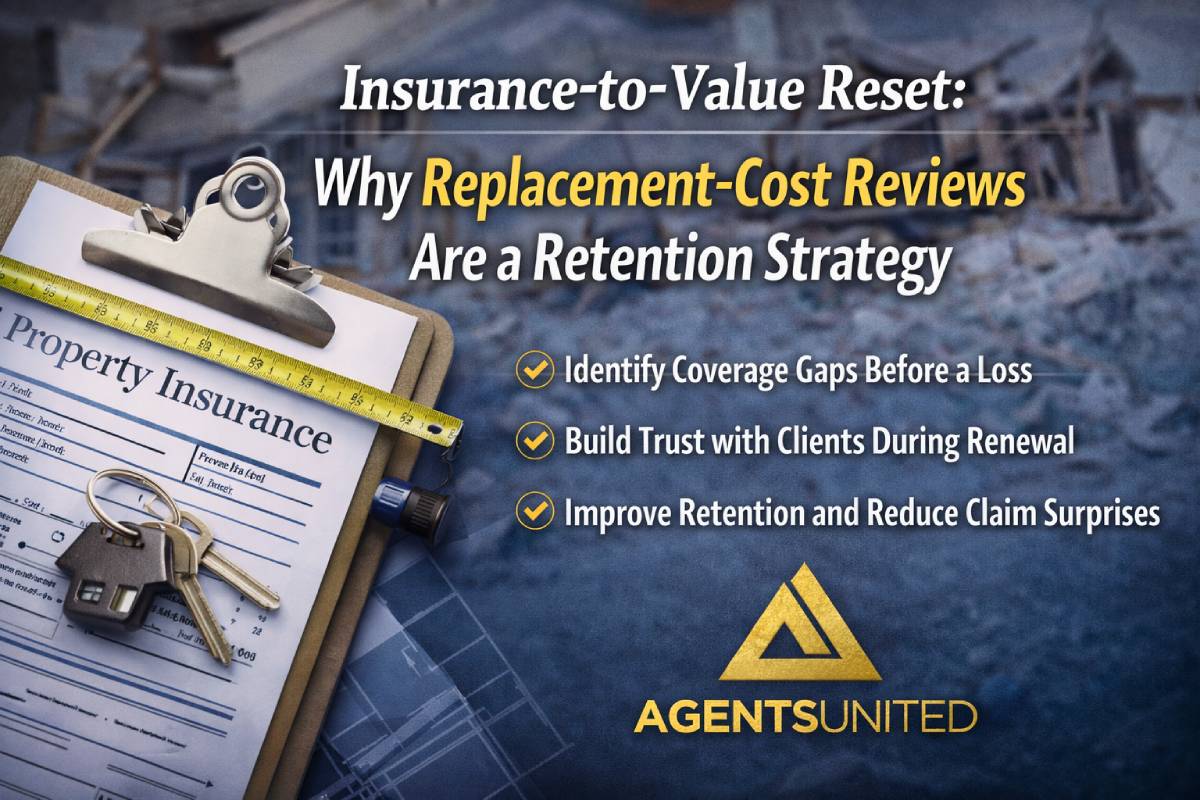
Insurance-to-Value: Many agencies still treat replacement-cost reviews like a box to check, and that’s a mistake.
The valuation problem did not disappear just because some markets are less chaotic than they were a year or two ago. Triple-I reports that repair and rebuilding expenses have jumped nearly 30% over the past five years, driven by inflation, labor shortages, material costs, supply-chain issues, and tariffs. AM Best likewise says homeowners insurers still face inflationary pressure and uncertainty around tariff impacts on loss costs. Verisk’s 360Value report adds that residential reconstruction costs increased 4.0% from July 2024 to July 2025, with increases in every state.
That matters because valuation drift is one of the easiest ways to lose trust. A client can tolerate a tough market if they believe you are helping them stay protected. But if they have a major loss and discover the building was undervalued, the relationship changes fast.
Independent agents should treat insurance-to-value as a service conversation, not just an underwriting requirement.
Start with this question: “If this property had a major loss tomorrow, would the current limit still make sense at today’s labor and material costs?” Too often the answer is based on last year’s number plus a small inflation factor. That is not always enough.
For personal lines, this means reviewing square footage, quality grade, roof type, special features, detached structures, and local reconstruction conditions. For commercial accounts, it means revisiting building values, tenant improvements and betterments, equipment, signage, code-upgrade exposure, debris removal assumptions, and business personal property values.
It also means talking honestly about coinsurance and sublimits. Clients may think they are “covered for replacement cost,” but if valuation inputs are stale, that promise may not work the way they expect. The same goes for ordinance or law coverage. In older buildings, code upgrades can become a painful gap after a major loss.
There is a retention upside here too. A real valuation review gives agents a reason to call before renewal season becomes a rush. It creates a professional touchpoint that feels consultative rather than transactional. It also helps justify premium changes with something more credible than “the market did it.”
A strong review process should include updated property characteristics, recent renovations, occupancy changes, protection features, catastrophe exposure, and a conversation about deductible tolerance. Some clients may prefer to carry more risk through deductible structure. Others need limit adequacy more than short-term premium relief. Your value is helping them make that tradeoff consciously.
In a softer property environment, it can be tempting to compete on rate alone, Do Not. The rate is memorable for about 30 days. A well-handled claim is memorable for years.
Insurance-to-Value i.e. replacement-cost reviews are not just an underwriting chore, they are one of the clearest ways an independent agent can protect retention, reduce unpleasant claim surprises, and prove advisory value.