Condo Insurance
Condominium and community-association insurance is no longer a niche headache. It is becoming one of the clearest tests of an agent’s ability to lead clients through complexity. According to Community Associations Institute data published in 2025, 91% of community associations experienced insurance premium increases, 17% saw increases over 100%, 23% shifted to surplus lines carriers, and 20% lost access to one or more carriers. Separate survey findings also show 29% reporting forced high deductibles or per-unit deductibles, while many associations funded premium increases through higher regular assessments or special assessments.
For independent agents, that means the job is no longer just “find the master policy.” The real job is helping boards, property managers, and unit owners understand where the pressure points are and what gaps can open when the market hardens.
This is where good agents separate themselves.
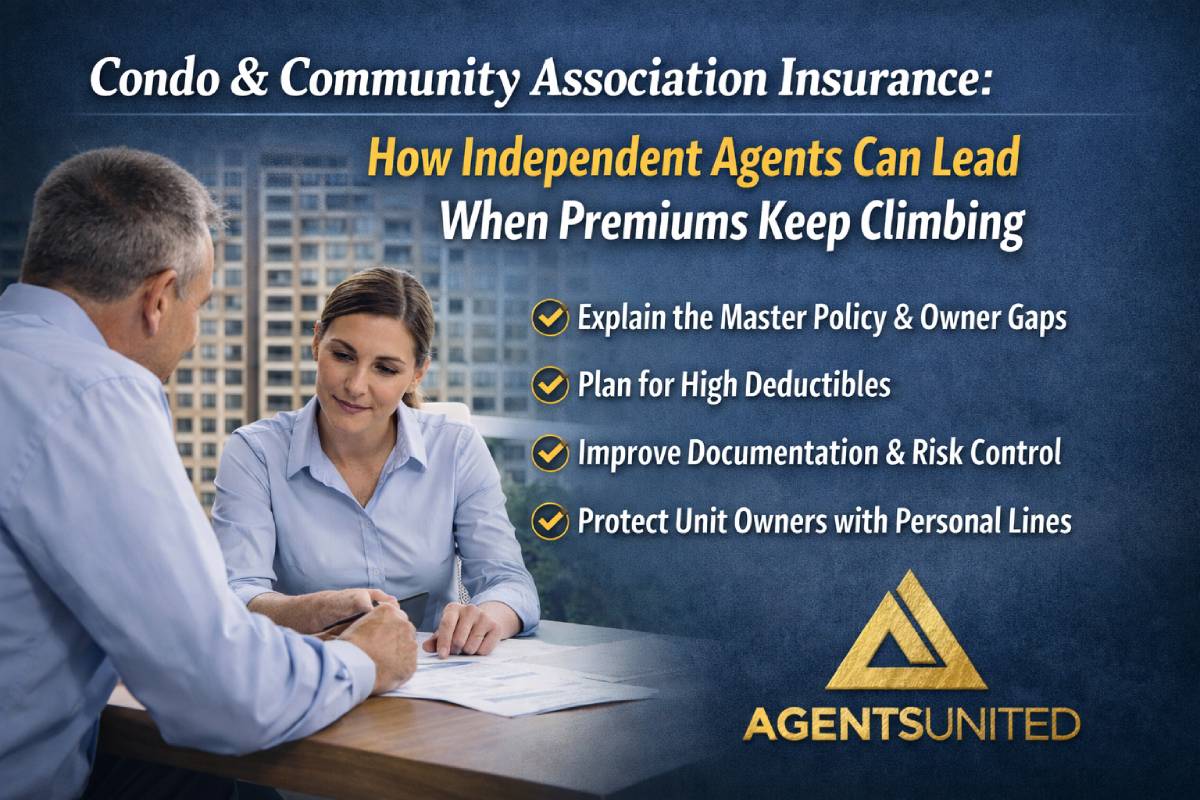
First, master-policy education matters more than ever. Many association clients assume the master policy solves everything. It does not. Agents need to clearly explain the difference between association coverage and unit-owner responsibility, especially around interior finishes, betterment’s and improvements, assessment exposure, and large deductibles. If the master policy deductible jumps, the unit owner’s personal policy conversation changes too.
Second, deductible strategy is now a planning issue, not just a renewal surprise. If the carrier imposes a large wind, water, or per-unit deductible, boards need a realistic funding plan. Can reserves absorb it? Would a special assessment be required? How will that affect owners financially and politically? Agents who ask these questions early look proactive; agents who wait until bind order time look replaceable.
Third, documentation and maintenance are becoming part of placement strategy. Roof age, plumbing updates, electrical modernization, reserve discipline, inspection routines, and loss-history narratives all influence how the account is received. The better the risk story, the more options an agent may preserve.
Fourth, associations often need a broader conversation than property alone. D&O, fidelity/crime, cyber, ordinance or law, equipment breakdown, flood, and excess liability all deserve attention. A client under stress may want to strip coverage to offset premium increases. Your role is to help them distinguish between smart restructuring and dangerous under-insurance.
There is also a strong personal-lines angle here. Every stressed condo association creates confused unit owners. That confusion can become an opportunity for independent agents to write better HO-6 coverage, explain loss-assessment limits, review water and sewer backup, and protect clients from master-policy misunderstandings.
In 2026, condo and association insurance is not just about finding capacity. It is about translating complexity into action.
The independent agents who win in this space will be the ones who can explain the master policy, the deductible, the reserve impact, and the unit-owner gap in plain English before a claim proves the point.