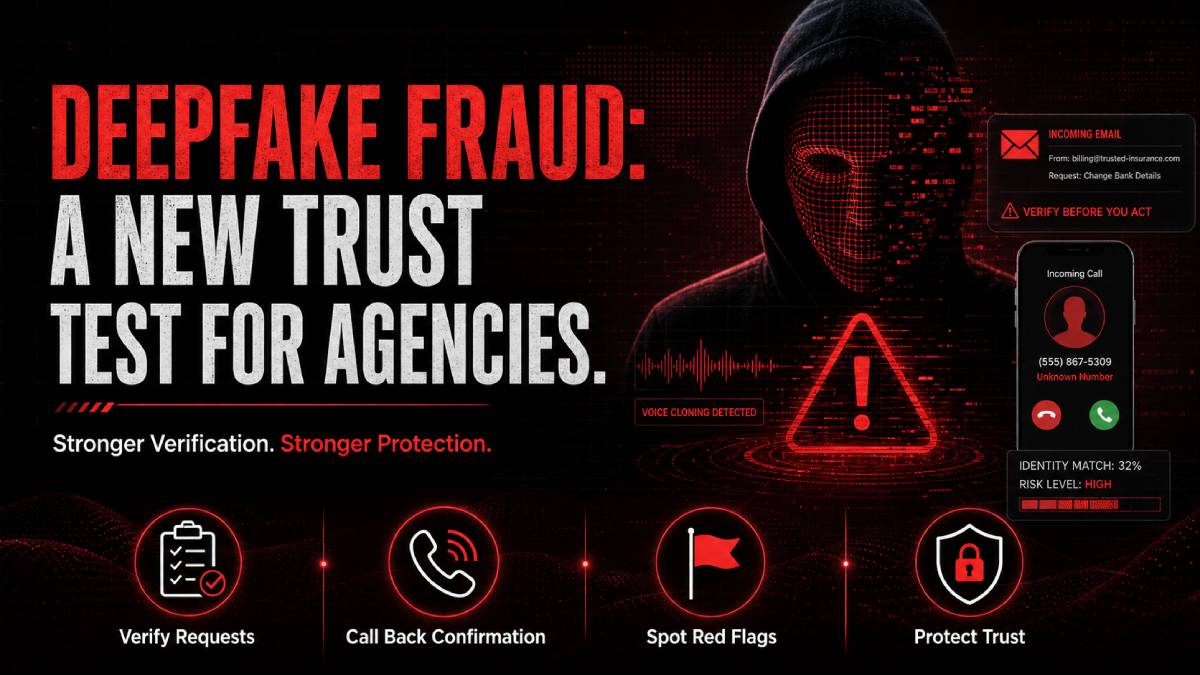
Deepfake Fraud: A New Trust Test for Agencies
Insurance fraud is entering a new era.
The old warning signs are no longer enough. With AI editing tools, manipulated photos, altered documents, synthetic voices, fake videos, and realistic impersonation attempts are becoming easier to create and harder to detect.
A study found that AI-powered editing tools are lowering the barrier to digital fraud. It also reported that one in three consumers would consider digitally altering an insurance claim image or document to strengthen their case, while insurers report that manipulated media submissions are becoming more sophisticated.
For independent agencies, this is not only a carrier problem. It is a trust problem.
Why Agencies Should Pay Attention
Most independent agencies are not responsible for carrier claim investigations. But agencies are often involved in the early moments when clients ask questions, submit documents, update policies, request changes, or seek guidance.
That creates exposure.
Fraud risk can show up in several ways:
- Fake change requests
- Altered claim photos
- Suspicious proof-of-repair documents
- Impersonation of clients or business owners
- Payment redirection attempts
- Fake certificates or contracts
- Voice or email impersonation of decision-makers
As digital tools get more convincing, agencies need stronger verification habits.
Make Verification Normal
The best way to reduce friction is to make verification part of the agency culture.
Clients should not feel singled out when the agency verifies a request. They should understand that verification protects them.
For example:
“Because we take client security seriously, we verify certain policy changes, billing requests, and sensitive updates before processing them.”
That language turns a security step into a service benefit.
Create a Callback Rule
One of the simplest controls is also one of the most effective: call back using a known number.
If a client emails a request to change payment information, update mailing details, add or remove a vehicle, change coverage, request documents, or authorize a major account change, the agency should verify the request through an established contact method.
Do not rely only on the phone number or email address included in the suspicious message.
Train Staff on Digital Red Flags
Every team member should know what to watch for.
Possible red flags include:
- Unusual urgency
- Requests to bypass normal process
- New payment instructions
- Slightly altered email addresses
- Poorly matched signatures
- Unusual attachments
- Client behavior that feels out of pattern
- Pressure not to call or verify
Deepfake and AI-enabled fraud can look polished. That is why process matters more than instinct alone.
Help Clients Understand the Risk
Fraud education can become a client touchpoint.
Agencies can send simple reminders explaining:
- How the agency verifies sensitive requests
- Why clients should be careful with insurance documents
- What to do if they receive a suspicious message
- Why claims documentation must be accurate
- How fraud can affect premiums for everyone
This positions the agency as proactive, not reactive.
Document the Process
If a sensitive request is verified, document it.
Note who confirmed the request, when it was confirmed, what method was used, and what action was taken. Documentation protects the agency, supports team consistency, and creates a clear record if questions come up later.
Where Agents United Fits
Agents United supports independent agencies with resources, training, tools, carrier access, and ongoing business support. (Agents United) As fraud risks evolve, agencies benefit from being connected to a larger network of professionals who are seeing similar challenges and sharing practical solutions.
Final Thought
Deepfake fraud is not just about technology. It is about trust.
Independent agents have always been relationship-driven advisors. In a world where images, voices, and documents can be manipulated, that trusted relationship becomes even more valuable.
The agencies that build strong verification habits today will be better positioned to protect clients, staff, carriers, and their own reputation tomorrow.
Want to strengthen your agency with better support, carrier access, and a network built for independent agents? Contact Agents United to learn more.