 The quick take
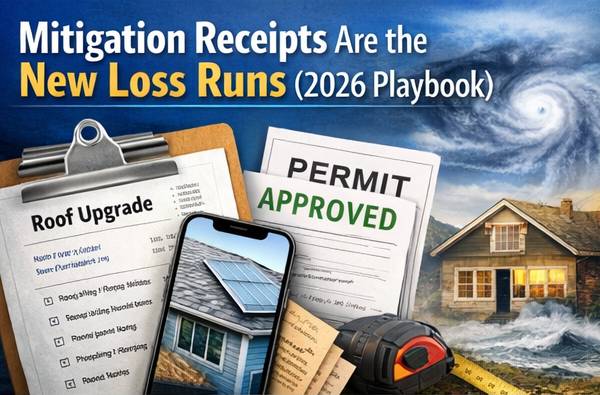
In 2026, a growing share of underwriting decisions are going to be driven by models, data, and verification—not just conversations. That’s why “we replaced the roof” isn’t enough anymore. Agencies that build a simple, repeatable way to collect proof of mitigation (photos, permits, invoices, inspection notes, sensor receipts) are seeing better outcomes: more yeses, fewer surprises, and smoother renewals. This aligns with the broader push toward modernization and more sophisticated risk evaluation across the industry.
Why this is showing up everywhere
Carriers are under pressure from catastrophic weather, rising loss costs, and the need to be more precise about risk selection. One of the biggest shifts is that underwriting is increasingly “document-driven”: if a risk improvement can’t be verified, it often doesn’t get priced—or even considered—correctly.
The good news: mitigation works. In a real-world study of Hurricane Sally, IBHS FORTIFIED homes saw meaningfully better outcomes (lower claim frequency and severity) than standard construction—evidence that verified resilience can reduce losses.
The 2026 underwriting reality: “Show me the evidence”
Underwriters aren’t asking for proof to be difficult. They’re asking because:
- Data quality matters more when appetite is narrow.
- Third-party property data can be wrong or outdated.
- Verified upgrades reduce uncertainty.
When you provide a clean “mitigation packet,” you reduce the back-and-forth, help the underwriter defend the pricing decision internally, and protect your client from last-minute requests.
Homeowners: the “Big 5” proofs that move the needle
Even when carriers don’t advertise credits, these five categories reduce friction at renewal:
- Roof (invoice, permit, warranty, photos)
- Water loss prevention (shutoff valve, sensors, updated supply lines)
- Wildfire/hail/hurricane resilience (region-specific; photos + receipts)
- Electrical (panel upgrade evidence, electrician invoice)
- Secondary structures & exposures (trees, drainage, outbuildings)
If your client is eligible for a verified resilience program (like FORTIFIED, where available), the documentation and inspection-based designation can make a measurable difference.
Small commercial property: win renewals with “risk controls proof”
For BOP and light commercial, underwriters commonly want evidence of:
- Roof condition + maintenance
- Sprinkler/alarms (inspection tags/certificates)
- Housekeeping/operations controls
- Security systems and lighting
- Any formal safety program (simple written SOP is fine)
Pro move: add a photo walk-through (10–20 photos) and label them. It’s fast, and it removes ambiguity.
How to operationalize this in your agency (without adding chaos)
Build it into your workflow:
- New business: require the Risk Resume + 3 proof docs minimum
- 60–90 days pre-renewal: request updates + new receipts
- CRM tags: “roof verified,” “water shutoff,” “sprinkler certified,” etc.
- Template email: “Send us any upgrades since last renewal—photos + receipts help underwriting.”
This is a service differentiator clients understand: “We help you prove you’re a better risk.”
Where Agents United fits
Agents United supports independent P/C agencies with carrier access, training, tools, and ongoing support—the exact ingredients that make standardized mitigation workflows easier to deploy across the agency.