D&O Insurance May Be Changing Again: What Independent Agents Should Watch
For several years, directors and officers liability insurance benefited from significant market competition.
Capacity increased. Pricing became more favorable for many accounts. Buyers often had opportunities to negotiate broader coverage or improve program structure.
But independent agents should not assume those conditions will remain unchanged.
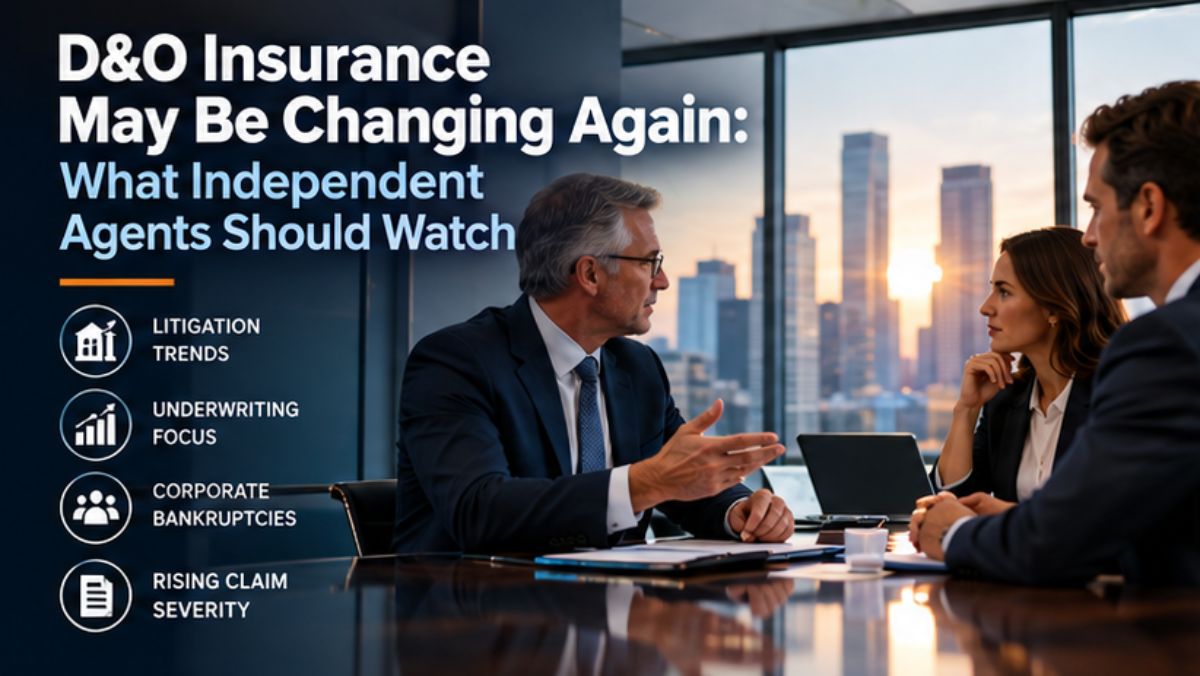
Industry reporting in September 2026 indicates that the U.S. D&O market remains profitable but is showing signs that conditions could begin tightening for certain risks. Rising securities litigation, increasing claim severity, corporate bankruptcies, changing capital-market activity, and emerging artificial-intelligence allegations are among the factors receiving increased underwriting attention.
That does not mean every D&O account is suddenly entering a hard market.
It means agents have another reason to start renewal conversations early.
D&O Risk Changes Faster Than the Renewal Application
A company’s management-liability exposure can change significantly in twelve months.
Consider what might happen between renewals:
- A company raises outside capital.
- Ownership changes.
- Revenue falls unexpectedly.
- A major acquisition takes place.
- Employees are laid off.
- The business enters a new market.
- Debt increases.
- A competitor files a lawsuit.
- The company adopts artificial intelligence.
- Investors receive new financial projections.
- The organization considers an IPO.
- Senior leadership changes.
- The company experiences a cyber incident.
- Liquidity becomes strained.
Any of these developments could change how an underwriter views the risk.
Waiting until 30 days before expiration makes it more difficult to tell the story properly.
Private Companies Need the Conversation Too
D&O is sometimes associated primarily with public companies and shareholder litigation.
Private businesses also face management-liability exposures.
Owners, executives, boards, investors, lenders, employees, competitors, customers, and regulators can all become sources of allegations.
Private-company financial stress is receiving particular underwriting attention. Corporate Chapter 11 filings increased again in 2025, according to industry reporting, creating additional focus on liquidity, financial condition, and insolvency-related risk.
That makes financial context increasingly important in a management-liability submission.
Build the Management Risk Story Before Marketing the Account
A good submission should do more than send applications and financial statements.
Help underwriters understand the company.
That might include:
Financial direction. Is revenue increasing, stable, or declining?
Capital structure. Has financing changed?
Leadership. Have there been significant executive or board changes?
Litigation. Are there known disputes or circumstances?
Growth strategy. Is the business acquiring companies, entering markets, or launching products?
Governance. How does leadership oversee major risks?
Technology exposure. Is AI or other automated technology materially involved in company decisions, products, employment practices, or disclosures?
The stronger the narrative, the easier it becomes for an underwriter to distinguish one company from another.
Do Not Review D&O in Isolation
Management-liability risks frequently intersect.
A company may need conversations around:
- Directors and officers liability.
- Employment practices liability.
- Fiduciary liability.
- Crime.
- Cyber insurance.
- Professional liability.
- Kidnap and ransom.
- Excess liability.
- Side A DIC coverage for larger organizations.
The right structure depends on the client.
The independent agent’s advantage is being able to look across multiple markets and coverage options rather than treating D&O as a standalone commodity.
Start Earlier When the Risk Is Changing
If an insured has experienced a major financial, operational, ownership, or leadership change, consider starting the renewal process well before the traditional timeline.
An early start creates time to:
- Gather information.
- Develop the narrative.
- Answer underwriting questions.
- Review loss history.
- Evaluate limits.
- Explore competing markets.
- Negotiate terms.
- Discuss exclusions.
- Coordinate towers when necessary.
A difficult account rarely improves because everyone waits longer to work on it.
Use Market Competition Strategically
Capacity is still available for many D&O risks, and stronger accounts may continue to find favorable options. However, higher-risk industries and financially stressed organizations can face more cautious underwriting and different capacity decisions.
That makes carrier access increasingly important.
An independent agency with multiple market relationships may have more flexibility when one carrier changes appetite or underwriting requirements.
Where Agents United Fits
Agents United helps independent P&C agencies strengthen their market position through direct carrier access, Access Plus, training, carrier relationships, profit-sharing opportunities, and ongoing business support.
Management-liability conditions may not change evenly.
That is exactly why independent agents should be watching.
The best time to discover that an account has become more difficult is not two weeks before renewal.
It is early enough to do something about it.