
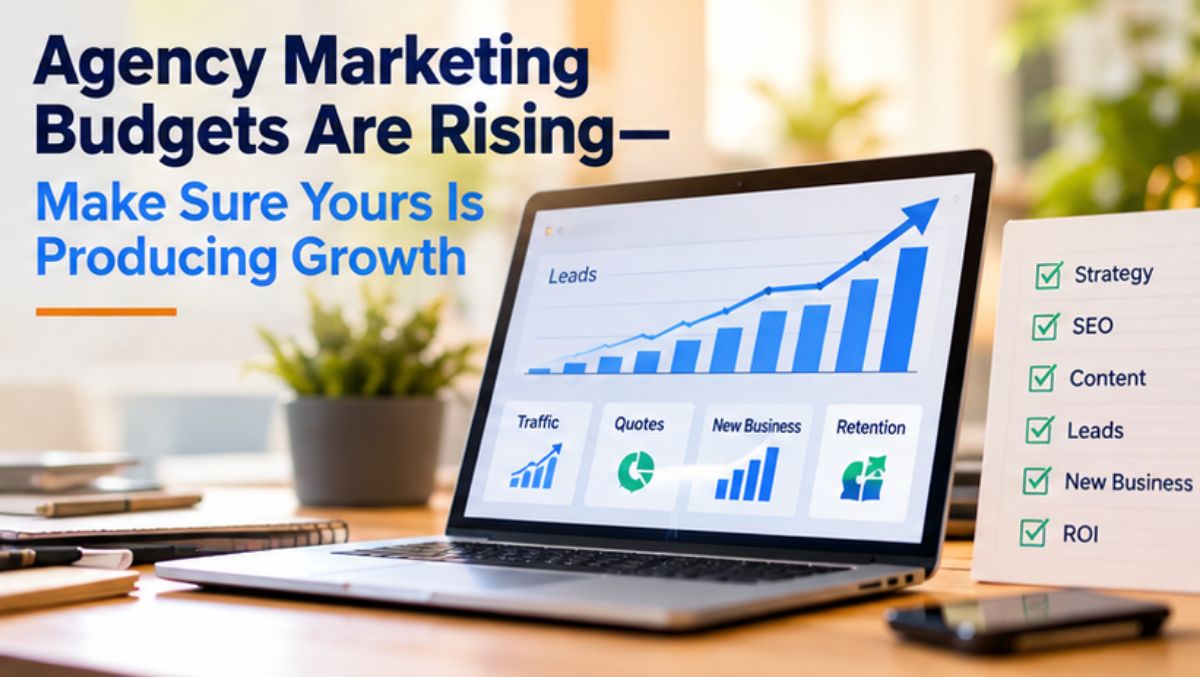
Agency Marketing Budgets Are Rising—Make Sure Yours Is Producing Growth
Independent insurance agencies are spending more money on marketing.
The bigger question is whether they know what that money is producing.
The Big “I” 2026 Agency Universe Study found that average agency marketing budgets increased from approximately $14,300 in 2024 to $20,600 in 2026.
Social media and digital marketing were the most commonly cited leading marketing activities, followed by Google Business, search engine optimization and agency websites.
That is a significant shift.
Marketing is becoming a larger agency investment.
It should also become a more measurable one.
Stop Measuring Marketing Only by Activity
Agencies are busy producing marketing.
They post to Facebook.
Send newsletters.
Sponsor community events.
Run Google Ads.
Publish blogs.
Update Google Business Profiles.
Ask for reviews.
Send producer emails.
Build landing pages.
Create videos.
Attend networking events.
But activity is not the same as performance.
An agency can publish every week without generating meaningful new business.
The goal should not be more marketing.
The goal should be marketing that creates the right opportunities.
Build a Simple Agency Marketing Scorecard
Every agency does not need an advanced analytics department.
Start with a few meaningful numbers.
Track:
Leads by source. Where did the prospect come from?
Quotes by source. Which channels produce actual insurance opportunities rather than low-quality inquiries?
Bound accounts by source. Which marketing channels turn into customers?
Average account value. A source generating fewer high-quality commercial accounts may outperform one generating many small leads.
Cross-sell opportunities. Does marketing generate additional policies from existing clients?
Cost per acquisition. How much did the agency spend to acquire a new account?
Retention by source. Do clients acquired through one channel remain longer than clients acquired through another?
These numbers help turn marketing from a collection of tactics into a business strategy.
Local Search Still Matters
Social media often gets the attention.
Local search can capture prospects when they are already looking for an insurance solution.
That makes the agency’s Google Business Profile, online reviews, website, local SEO, and consistent business information important components of visibility.
Make sure the agency’s:
Business name is consistent.
Address and phone information are correct.
Business categories are appropriate.
Office hours are current.
Website links work.
Reviews are being generated consistently.
Services are clearly described.
Photos are current and professional.
Google Business and SEO should not be treated as “set it and forget it” projects.
They are digital storefronts.
Build Content Around Accounts You Actually Want
One of the easiest ways to waste a marketing budget is creating generic content for everyone.
Instead, connect marketing to the agency’s growth priorities.
If you want more contractors, create contractor insurance content.
If you want restaurant accounts, build restaurant risk resources.
If you want affluent personal lines clients, address secondary homes, umbrella coverage, valuables, watercraft, and risk management.
If you want property owners, discuss landlord exposures, habitational risks, building values, water damage, liability, and loss control.
A focused marketing strategy helps prospects recognize that the agency understands their business.
Give Producers Something They Can Use
Marketing should also support sales.
Every campaign can create tools for producers:
- A short email.
- A prospecting list.
- A landing page.
- A coverage checklist.
- A one-page PDF.
- A social post.
- A renewal conversation.
- A client webinar.
- A referral-partner message.
When marketing and production operate independently, agencies often create content that looks good but never enters the sales process.
Connect the two.
Protect the Budget From Vanity Metrics
Followers are useful.
Website visits are useful.
Email opens are useful.
But they are intermediate measurements.
The business outcomes are accounts, revenue, retention, account rounding, and profitable growth.
That means an agency should periodically ask:
- Which marketing activity generated business?
- Which produced qualified opportunities?
- Which created no measurable results?
- What should we increase?
- What should we test?
- What should we stop doing?
Marketing budgets do not need to increase every year simply because industry averages are increasing.
They need to become smarter.
Where Agents United Fits
Agents United supports member agencies with marketing resources, education, training, business-development tools, carrier access, productivity resources, and profit-sharing opportunities designed to help independent agencies grow while retaining their independence.
The 2026 Agency Universe Study shows that agencies are investing more heavily in marketing.
The next competitive advantage will come from knowing which investments actually work.
Spend with a purpose.
Measure what happens.
Then put more resources behind the marketing that produces the type of business your agency wants to write.