
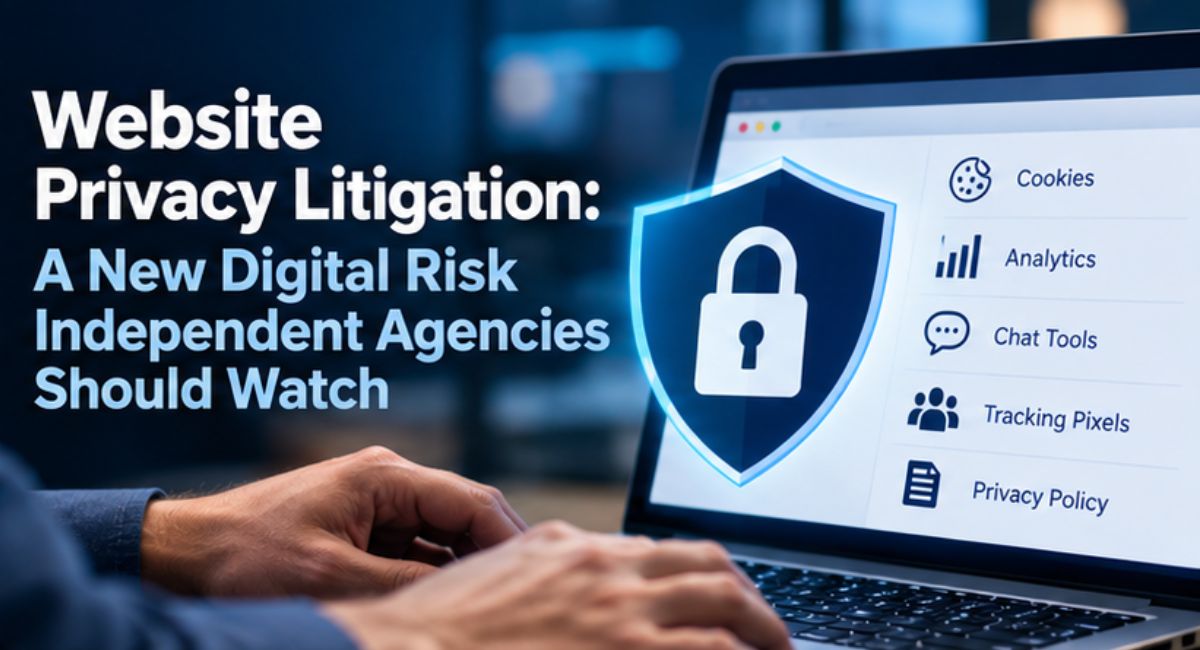
Website Privacy Litigation: A New Digital Risk Independent Agencies Should Watch
Independent insurance agencies have become more sophisticated digital marketers.
Agency websites now commonly include analytics platforms, contact forms, online quoting tools, chat systems, advertising pixels, scheduling applications, embedded videos, social-media integrations, and customer-service technology.
Each tool can improve marketing or client service.
But each can also collect or transmit information.
That is becoming an important risk-management issue.
In September 2026, the Big “I” warned independent agencies about increasing website privacy litigation involving allegations that websites collected, recorded, or shared visitor information without sufficient notice or consent. The organization noted that these claims are beginning to expand beyond major technology companies to other consumer-facing businesses using analytics, tracking cookies, chat features, and similar tools.
For independent insurance agencies, website privacy is no longer strictly an IT issue.
It deserves attention from agency ownership, marketing teams, technology vendors, compliance professionals, and E&O risk managers.
Your Website May Be Doing More Than You Realize
Many agencies do not intentionally collect large amounts of website visitor data.
Their technology does it automatically.
A marketing team may install a tracking pixel to measure advertising.
A website developer may add analytics.
A chat provider may record interactions.
A scheduling application may collect contact information.
A form may connect to a CRM.
A video platform may place cookies when someone visits a page.
Individually, each tool may seem routine.
Together, they create a digital ecosystem that agencies should understand.
Start With a Website Technology Inventory
One practical first step is documenting what is actually running on the agency website.
Review:
- Analytics platforms.
- Advertising pixels.
- Cookies.
- CRM integrations.
- Contact and quote forms.
- Chatbots and live-chat systems.
- Appointment schedulers.
- Embedded videos.
- Call-tracking technology.
- Customer portals.
- Third-party plugins.
- Retargeting tools.
- Lead-generation services.
The goal is not automatically to remove these technologies.
It is to understand what they collect, where information goes, and whether the agency’s disclosures reflect current practices.
Do Not Let the Privacy Policy Become a Forgotten Page
Many websites have a privacy policy because someone created one when the site launched.
Then the website changes.
New software is installed. Advertising platforms change. Forms are replaced. Chat is added. Analytics tools evolve.
The privacy policy does not.
That creates a disconnect between what the website says and what the website actually does.
Agencies should consider having appropriate legal or compliance professionals review their privacy notices periodically and whenever meaningful technology changes are made.
Website privacy requirements can vary by jurisdiction and circumstances, so agencies should avoid relying on generic templates as a substitute for qualified guidance.
Include Vendors in the Conversation
Agencies increasingly rely on third parties for website hosting, marketing automation, forms, CRM systems, analytics, email marketing, chat, payment processing, and advertising.
That means digital risk extends beyond software installed directly by agency employees.
Ask vendors:
- What information is collected?
- Where is it stored?
- Is information shared with additional providers?
- How long is data retained?
- What security controls are used?
- What settings can the agency control?
- Who is responsible for privacy notices and consent mechanisms?
- A new marketing tool should not automatically go live simply because it produces more leads.
- Its data practices should also be understood.
This Is Also a Client Conversation
Website privacy litigation creates another reason independent agents should discuss cyber, technology, media, professional liability, and management exposures with commercial clients.
Many small and midsize businesses use the same digital tools agencies use.
A restaurant, retailer, professional-services company, contractor, medical office, nonprofit, or manufacturer may have sophisticated tracking technology without realizing it.
Independent agents do not need to become privacy attorneys.
They do need to recognize when a changing business practice may create an insurance conversation.
Create a Digital-Risk Review
Consider adding several questions to commercial account reviews:
- Has the company redesigned its website?
- Has it added online sales?
- Does it use website chat?
- Has it added tracking or advertising technology?
- Does it collect customer information online?
- Has it launched a mobile application?
- Is it using new CRM or marketing software?
- Does it have a current privacy policy?
Those questions can uncover changes that traditional insurance applications may not reveal.
Where Agents United Fits
Emerging risks can be difficult for an independent agency to navigate alone.
Agents United gives independent agencies access to carrier relationships, training, market resources, business support, and Access Plus opportunities that can help agencies address changing client needs while remaining independent.
Website technology is becoming more powerful.
That makes understanding the risk behind the technology increasingly important.
For independent agents, privacy awareness can protect the agency itself while creating a more informed conversation with commercial clients.