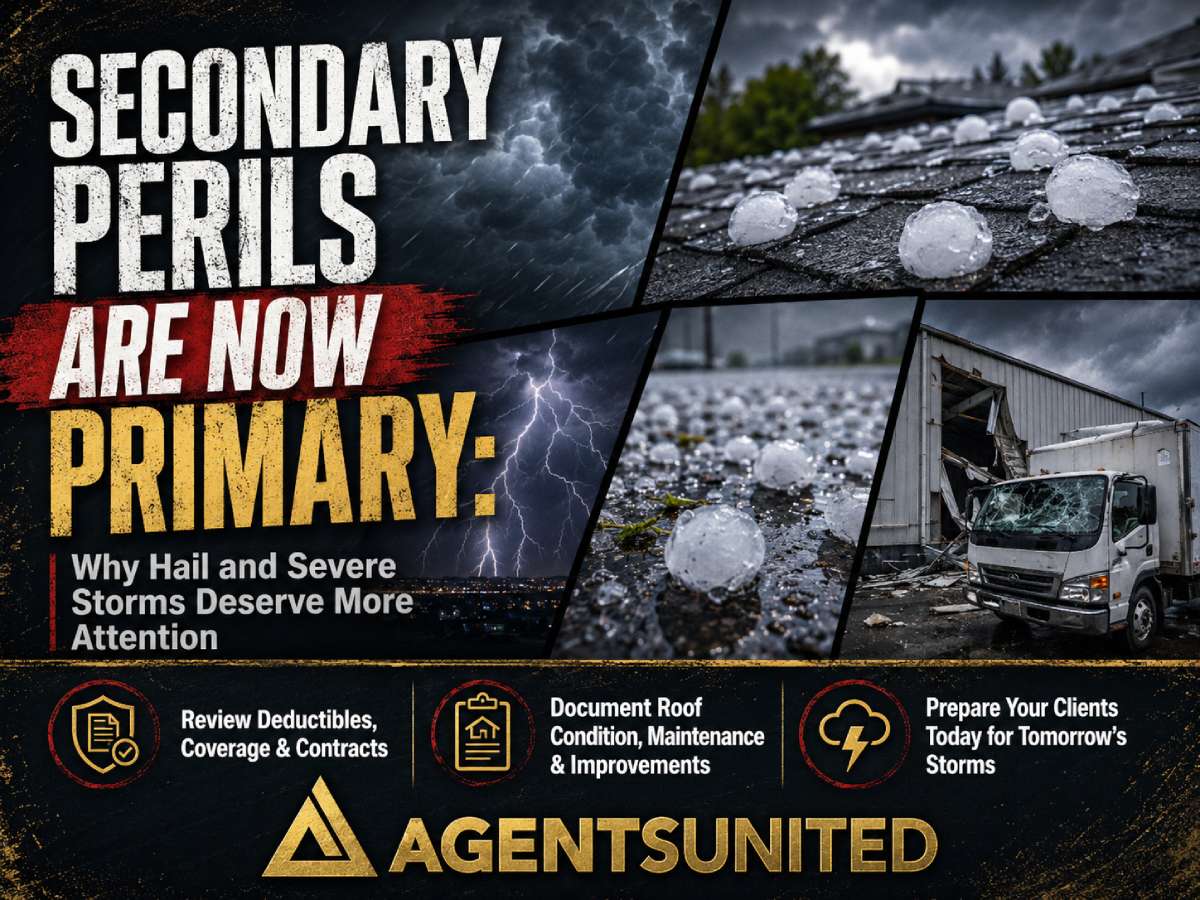
Secondary Perils Are Now Primary: Why Hail and Severe Storms Deserve More Attention
When clients think about catastrophic property losses, hurricanes, earthquakes, and wildfires usually come to mind first.
The insurance industry’s loss data tells a broader story.
Severe convective storms—including hail, tornadoes, thunderstorms, and straight-line winds—have become one of the largest sources of insured property losses in the United States.
A recent report noted that severe convective storms generated approximately $51 billion in U.S. insured losses during 2025, marking the third consecutive year that losses exceeded $50 billion.
The first half of 2026 was quieter than the previous several years, according to Moody’s, but the underlying exposure has not disappeared. (Moody’s)
For independent agents, this means the storm conversation needs to extend well beyond hurricane season.
Hail Is Becoming a Major Property Insurance Issue
Hail can damage:
- Roofing
- Siding
- Windows
- HVAC equipment
- Vehicles
- Solar panels
- Signs
- Outdoor equipment
- Commercial rooftops
Unlike a major hurricane, hail losses can occur across numerous states every year.
That geographic reach is one reason severe convective storms have become so important to property insurers.
Clients May Not Understand Their Wind and Hail Terms
A client may say:
“I have property insurance.”
That does not necessarily mean they understand how their policy responds to hail or wind.
Depending on the policy, carrier, property, and geography, agents may need to explain:
- Percentage wind/hail deductibles
- Separate storm deductibles
- Actual cash value roof settlements
- Roof-age restrictions
- Cosmetic damage exclusions
- Matching limitations
- Protective-device requirements
- Roof maintenance expectations
These provisions can make an enormous difference after a loss.
The best time to explain them is before the storm.
Roof Information Is Becoming Insurance Information
Roof condition has become an increasingly important underwriting variable for both personal and commercial property.
Agents should know more than the year the building was constructed.
Useful information may include:
- Roof age
- Roofing material
- Replacement date
- Permit documentation
- Inspection reports
- Maintenance history
- Prior storm damage
- Roof improvements
When a client replaces or upgrades a roof, encourage them to keep invoices, permits, warranties, photographs, inspection reports, and other documentation.
That information may become valuable during underwriting, renewal, or a future claim.
Commercial Clients Need a Broader Storm Review
For businesses, storm exposure extends beyond physical building damage.
A severe storm could also create:
- Business interruption
- Equipment breakdown
- Vehicle damage
- Spoilage
- Utility interruption
- Supply-chain delays
- Outdoor-property losses
- Lost income during repairs
A manufacturing operation may be unable to produce.
A retailer may have to close.
A contractor may lose vehicles and equipment.
A solar facility may experience widespread panel damage.
Agents should review both the physical property and the operational consequences of storm damage.
Use Renewal Reviews to Discuss Resilience
Risk mitigation is increasingly becoming part of insurance strategy.
Independent agents can encourage property owners to evaluate measures such as:
- Impact-resistant roofing materials
- Roof inspections
- Regular maintenance
- Improved drainage
- Protected outdoor equipment
- Vehicle relocation procedures
- Emergency response plans
- Backup power
- Surge protection
- Updated property inventories
The objective is not to promise an insurance discount or underwriting outcome.
It is to help clients become better risks.
Do Not Let a Quiet Year Create Complacency
The reduced severe-storm losses during the first half of 2026 are good news.
But one quieter period does not erase the three consecutive years of $50-billion-plus insured losses that came before it. (Moody’s)
Insurance agencies should use periods of improving market conditions to prepare clients—not to stop talking about risk.
That can include reviewing deductibles, documenting improvements, updating property values, discussing business interruption, and identifying coverage restrictions.
Independent Advice Matters More When Policies Get Complicated
Property insurance is becoming increasingly specific to geography, construction, roof condition, carrier appetite, and mitigation.
That creates an important role for independent agents.
The value is not simply finding a premium.
It is helping the client understand what they purchased.
Access to multiple markets and broader underwriting knowledge can also become valuable as carrier approaches to severe-weather exposure differ.
Agents United supports independent P&C agencies with carrier access, agency resources, training, and support designed to help agencies compete while remaining independent.
Turn Weather Risk Into an Advisory Conversation
Hail and severe storms may once have been described as secondary perils.
From an insurance-loss perspective, there is increasingly nothing secondary about them.
Independent agents who help clients understand deductibles, roof requirements, property documentation, business interruption, and mitigation can turn a complicated underwriting trend into another opportunity to demonstrate the value of independent advice.