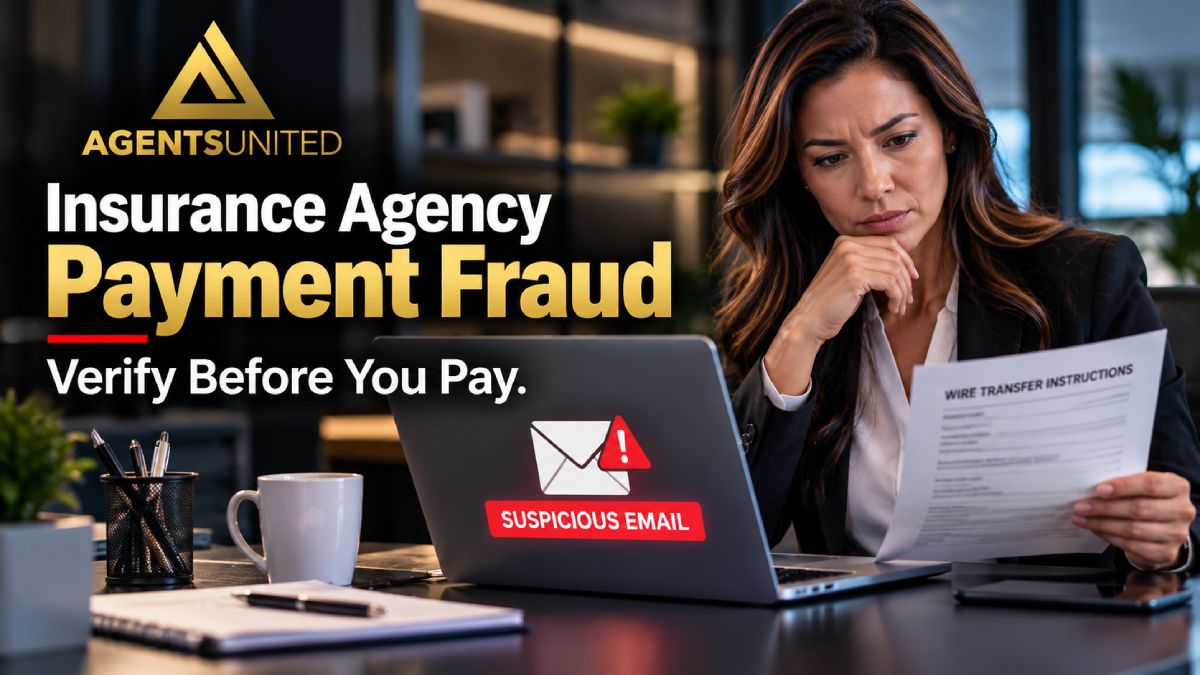
Insurance Agency Payment Fraud: How to Protect Your Agency From Costly Scams
Independent insurance agencies spend considerable time helping clients protect their homes, businesses, vehicles, and financial assets. But there is another risk agency owners cannot afford to overlook: fraud targeting the agency itself.
From impersonated clients to fraudulent payment instructions, today’s scams can exploit everyday insurance workflows. And with increasingly convincing emails, text messages, and AI-generated communications, identifying suspicious activity is not always easy.
For independent insurance agencies, the solution is not simply purchasing better technology. It is developing consistent procedures that help employees recognize warning signs, verify requests, and respond before a suspicious transaction becomes a financial loss.
Why Insurance Agencies Are Attractive Targets
Independent insurance agencies manage valuable information and frequently communicate with multiple parties, including policyholders, carriers, lenders, mortgage companies, and vendors.
These relationships create opportunities for criminals to impersonate legitimate contacts.
Consider a few common scenarios:
- An employee receives an email appearing to come from a carrier requesting updated banking information.
- A caller claiming to be a policyholder requests an urgent change to payment details.
- A vendor sends an invoice containing different account information from previous invoices.
- A producer receives a convincing message asking them to open a document or confirm account credentials.
In each situation, the request may initially appear routine.
The danger arises when an employee acts without independently verifying that the communication is legitimate.
1. Watch for Business Email Compromise
Business email compromise occurs when criminals use compromised or impersonated email accounts to trick recipients into transferring funds or revealing sensitive information.
An insurance agency may receive a message that appears to originate from a trusted carrier representative, accounting contact, or business partner.
The email might reference an actual invoice, policy transaction, or familiar business relationship.
That context can make the request appear credible.
Agency best practice: Establish a mandatory verification procedure for changes involving payment instructions, banking details, or sensitive account information.
Employees should contact the requesting party using a previously verified telephone number or established communication channel—not the contact information supplied in the suspicious message.
2. Establish Clear Payment Verification Procedures
Agencies should document how employees handle payment-related requests.
A practical verification process might include:
- Confirming the identity of the person requesting the transaction.
- Reviewing whether the request is consistent with established account activity.
- Independently verifying changes to banking or payment information.
- Requiring additional approval for higher-risk transactions.
- Documenting the verification and authorization process.
The objective is to create a repeatable workflow that protects the agency without unnecessarily delaying legitimate business.
Even smaller agencies can benefit from separating responsibilities so that one individual does not initiate, approve, and complete every sensitive transaction.
3. Train Employees to Recognize Urgency as a Warning Sign
Fraudulent requests frequently use urgency to pressure employees into bypassing normal procedures.
Common examples include:
- “The payment must be processed immediately.”
- “Our banking information changed this morning.”
- “Please keep this transaction confidential.”
- “I’m unavailable by phone, so just reply to this email.”
None of these statements automatically proves fraud.
However, unusual urgency combined with changed payment instructions or requests to bypass normal verification should prompt additional scrutiny.
Agency owners should encourage employees to question suspicious instructions, even when a request appears to come from management or an important business partner.
A strong fraud-prevention culture gives employees permission to verify before acting.
4. Protect Client Information During Routine Transactions
Fraud prevention extends beyond financial transfers.
Independent agencies routinely receive requests involving policy documents, driver information, property details, and other sensitive records.
Before releasing confidential information or making significant account changes, employees should follow established identity-verification procedures.
Agencies should also evaluate whether their current communication methods provide appropriate security for the information being transmitted.
For example, sensitive documents may be better handled through approved secure systems rather than ordinary email attachments.
The specific controls should reflect applicable privacy requirements, carrier expectations, and the agency’s operations.
5. Create a Response Plan Before an Incident Happens
Even well-trained employees can encounter sophisticated fraud attempts.
That is why agencies need a documented response plan.
If an employee suspects a fraudulent transaction or compromised account, the agency should have clear instructions for:
- Reporting the incident immediately to designated management.
- Contacting the relevant financial institution when funds may be at risk.
- Securing potentially compromised accounts and credentials.
- Preserving relevant communications and transaction records.
- Consulting appropriate cybersecurity, insurance, and legal professionals.
- Evaluating applicable notification and reporting obligations.
Speed can be critical when fraudulent payments are involved.
An agency should not wait until an incident occurs to decide who is responsible for coordinating its response.
6. Review Fraud Prevention as Part of Agency Operations
Fraud prevention should not be treated as a one-time employee training exercise.
Agency owners can incorporate basic reviews into regular operational meetings.
Questions worth asking include:
- Are employees consistently verifying changes to payment information?
- Do new hires understand the agency’s security procedures?
- Are financial transaction approvals clearly assigned?
- Have employees reported suspicious messages or requests?
- Are vendor and carrier contact records current?
- When were incident response procedures last reviewed?
These conversations help agency leadership identify weaknesses before they become larger problems.
They also reinforce an important message: protecting the agency is everyone’s responsibility.
How an Insurance Agency Network Can Support Stronger Operations
Independent agency owners frequently balance sales, customer service, staffing, carrier relationships, and administrative responsibilities.
Developing stronger internal processes can be challenging when resources are limited.
An established insurance agency network can provide access to professional relationships, training opportunities, operational resources, and shared industry knowledge that help agency owners make more informed decisions.
Agents United supports independent property and casualty agencies through carrier access, training, resources, and opportunities to strengthen their businesses.
Although membership does not eliminate fraud risk, access to a broader professional network can help agency owners stay informed and identify areas where operational improvements are needed.
Protect the Agency That Protects Your Clients
Insurance agency fraud prevention does not require every employee to become a cybersecurity expert.
It starts with practical habits: verify unusual requests, protect sensitive information, establish clear approval procedures, and prepare for potential incidents.
For independent agencies, those habits can help protect financial assets, client relationships, and the reputation they have worked hard to build.
Interested in strengthening your independent insurance agency?
Learn how Agents United helps independent agencies access carrier relationships, training, and business resources while maintaining their independence.