Referral partnerships have always mattered in insurance. But the old version of referral marketing—handing out business cards, attending mixers, and hoping someone remembers your name—is not enough anymore.
Today’s independent agencies need a more strategic approach. Centers of influence should not just be lead sources. They should be risk conversation partners.
The insurance market is more complex, clients are more price-sensitive, and digital channels are changing how people shop. At the same time, consolidation continues across the independent agency system. IA Magazine reported in June 2026 that there are almost 39,000 independent P&C agencies in the U.S., with roughly 750–800 changing hands each year. (IA Magazine)
For independent agencies that want to stay competitive, local relationships still matter. The key is making those relationships more intentional.
What Is a Center of Influence?
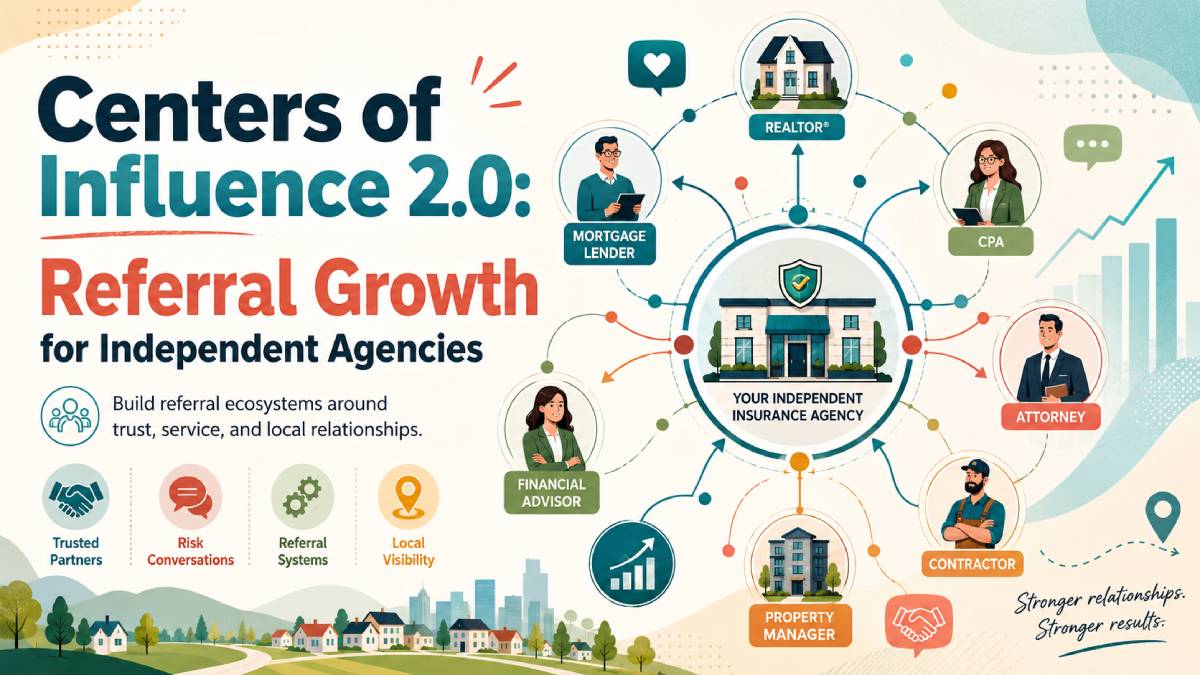
A center of influence is a person, business, or organization that regularly interacts with the same type of clients your agency wants to serve.
For personal lines, that may include:
- Realtors
- Mortgage lenders
- Home inspectors
- Auto dealers
- Financial advisors
- Estate planning attorneys
For commercial lines, that may include:
- CPAs
- Payroll providers
- HR consultants
- Business attorneys
- Contractors
- Property managers
- Industry associations
These partners often see important client changes before the insurance agency does. A new home purchase, business expansion, new vehicle, new employees, new lease, new equipment, or ownership change can all create insurance needs.
Move Beyond “Send Me Leads”
The strongest referral partnerships are not built on vague promises. They are built on clarity.
Instead of asking a partner to “send anyone who needs insurance,” define the exact risk triggers you can help with.
For example:
- “Send us clients buying older homes, second homes, or investment properties.”
- “Send us businesses hiring their first employees.”
- “Send us contractors adding vehicles or equipment.”
- “Send us property owners signing new leases.”
- “Send us clients who received a nonrenewal or major rate increase.”
This makes it easier for partners to recognize opportunities.
Create a Referral Service Standard
A partner is putting their reputation on the line when they refer someone to your agency. Make it easy for them to trust your process.
Create a simple referral standard that includes:
- How quickly your agency responds
- Who contacts the referred client
- What information you need upfront
- How you update the referral partner
- How you handle urgent coverage needs
- What compliance boundaries you follow
This professionalizes the relationship and helps prevent referrals from falling through the cracks.
Give Partners Useful Education
The best centers of influence do not just refer. They understand why the referral matters.
Create simple educational resources your partners can share, such as:
- “Insurance Questions to Ask Before Buying a Home”
- “Coverage Issues New Business Owners Often Miss”
- “What Contractors Should Review Before Taking Bigger Jobs”
- “Why Property Managers Need Proof of Coverage Updates”
- “Insurance Red Flags During a Real Estate Transaction”
These resources position your agency as a helpful expert and make your partners look good to their clients.
Use Local Trust to Compete With Digital Convenience
Digital insurance shopping is becoming easier, faster, and more common. J.D. Power found that shoppers are shifting toward digital channels, including mobile apps and AI tools, to compare and purchase policies. (JD Power)
Independent agents should not ignore that shift. But they also should not assume digital convenience eliminates the need for local advice.
A strong referral network gives independent agencies something digital platforms often struggle to replicate: trust at the moment of need. When a client’s realtor, CPA, lender, attorney, or business advisor says, “You should talk to this agency,” that recommendation carries weight.
Agents United Helps Agencies Build Smarter Growth
Referral growth works best when agencies have the market access, support, and operational confidence to serve the opportunities they create. Agents United helps independent agencies compete through carrier access, profit-sharing opportunities, training, tools, marketing, education, and management support.
Centers of influence are not just a marketing tactic. They are a growth system. When independent agencies build referral partnerships around risk, education, and service, they create stronger local visibility and better client conversations.
The agencies that win will not be the ones waiting for leads. They will be the ones building trusted referral ecosystems that bring the right opportunities to the door.